Wednesday, March 5, 2008

A Compromise on Wind Turbines ?

The meeting of the Zoning Board last Wednesday night marked a turning point for the wind energy debate in Ellis County. It was the first time some form of compromise seemed remotely possible. If turbines are kept far enough away from residents opposed to them, opposition to the project could be withdrawn.

The proposed Wind Energy Ordinance, drafted and submitted by myself on behalf of the ECEAC, sets out responsibilities for any developer of an industrial scale wind project in the county. The regulations provide residents with reasonable assurances that their rights and environment will be protected with respect to both inevitable and potential impacts. Only two of these were discussed at the meeting: noise and setbacks.

We heard much confusing discussion about noise and decibels, sound and infrasound - a highly technical subject that few people present, if any, were able to fully comprehend. I would like to respond to remarks made by Dick Klaus who suggested that any noise ordinance should apply to all sources of sound, not just wind turbines. I agree that a general noise ordinance for the county would be a progressive step forward. However, the impulsive, aerodynamic nature of the sound produced by wind turbines cannot be compared to the sounds produced by farm equipment, transient traffic noise, or other forms of machinery.

Normal motorized machinery does not sweep more than an acre of air at a height of 400 feet with blade tips approaching speeds of 200 mph. It does not create pulsating, aerodynamic disturbances that result in penetrating, low frequency wave forms that can propagate more than a mile, under suitable atmospheric conditions. This is not noise you can hear as much as vibration you can feel. We are talking about waves of energy that can penetrate buildings and cause objects to resonate, depending on their unique resonation frequency, just like crystal can be shattered by a sound wave that matches its resonation frequency. Any discussion of decibels measured in the auditory range is completely irrelevant to these concerns. However, a consistent audible hum (single tones in the frequency of 100-600hz) can also propagate from wind turbines as a result of resonation of the gear box and torque arm bring transferred to the rotor and then radiated into the environment. This is similar to the hum of a large transformer, only on a much greater scale.

Lance Russell asked me for some evidence that people had been adversely affected by turbines placed too close to their residences. In response, I have submitted a package of material at the Environmental Office that contains the testimony and personal diaries of families who have been driven from their homes by turbine noise in Canada, United Kingdom, Denmark, Sweden, Italy and Maine. I have also included 5 selected abstracts of papers presented at the 2nd International Conference on Wind Turbine Noise held in Lyon, France, September 2007. This conference was attended by 150 presenters from 24 different countries. I have further included another abstract and two complete papers published in peer-reviewed journals that explain the unique nature and behavior of wind turbine noise under various atmospheric and topographic conditions. I can make copies available to anyone who is interested. It is my hope that the zoning board will take the time to review this material.

Anyone who doubts that turbines pose sufficient risk to require setbacks of half a mile from property lines should watch the video posted last week of a turbine exploding in Denmark due to its brakes failing under high wind conditions: http://tinyurl.com/yuhkw3. The turbine was only 200 feet tall, but debris was thrown as far as 1,600 feet.

Tuesday, March 4, 2008

We need a noise ordinance that is derived from scientifically accepted procedures

This letter is submitted by longtime Ellis County resident, Jacinta Faber:

I came away from last week's zoning commission meeting concerned about the lack of concern shown by our commission when it comes to a noise propagating industry being placed next to people's homes. It seems like 2007 all over again, just when I was hoping we could move into a more enlightened 2008.

A resident presented a proposed wind ordinance to the commission for its consideration. In the proposed ordinance, there are noise limitations (40dBA) for night time.

According to the World Health Organization, a maximum of 30dB(A) for continuous background noise is recommended for healthy sleep. Individual noise events exceeding 45dB(A) should be avoided. The WHO cautions that sustained noise at 45dBA or greater is cause for grave concern.

It is the noise at these levels, which can promote arterial ischemia and coronary incidents. The representative for Iberdrola, a Spanish company seeking to make money off the Hays wind project, stated the wind project was designed to allow for 45dB(A) at night.

Is it any wonder that we are pleading for social justice?

The corporate representative for the Iberdrola responded to this proposed noise limitation by insisting that there will be little noise, saying that the 400-foot turbines are quiet. Earlier this week, she referred to the wind turbine as a lullaby. I guess if your routine is to put your baby to sleep with an Ozzy Osborne heavy metal anthem, the turbine noise at night will be a welcome reprieve from those pesky crickets and hoot owls that have plagued your sleep in the past. If they are as quiet as that company employee contends, Iberdrola should have no problem accepting the noise limits proposed in the noise ordinance.

And Iberdrola would have no need to pay people to accept the good-neighbor agreements, which give them easements for noise levels exceeding 55dBA at night.

Something is very fishy here. If I sign the good-neighbor agreement offered by Iberdrola, I am recognizing and accepting conditions -- noise levels exceeding 55dBA -- which will cause my family and neighbors harm.

The corporate representative said her company did its own noise study last May.

Though Iberdrola has not been forthcoming with the results of that study, I believe that to protect the people of Ellis County we instead need an unbiased, independent, third-party noise study.

Most disconcerting for me is that our zoning commissioners seemed to show skepticism about the need for restricting noise, though it was unclear whether their skepticism extended to restricting noise from any source or restricting noise from only wind turbines.

Though I have expressed some frustration with the zoning commission, I do know that the zoning commissioners are all volunteers who generously give their time -- and I am grateful for their service.

On the other hand, the county commissioners are elected and are paid for their service, and they are ultimately responsible to us for properly accepting, modifying or rejecting proposed ordinances. If our elected county commissioners do not have the expertise or time to develop a meaningful noise ordinance with real teeth, it's time that we hire consultants with expertise in the areas of noise and health.

For our families' health and the responsible future of our county, we must have a noise ordinance derived from scientifically accepted procedures.

This is necessary in order to provide us with a foundation for making sound ethical judgments.

We should not place our children's health in the hands of a wind industry corporate spokesperson, one who is hungry for profits, big on spin and short on facts.

Submitted by:
Jacinta Faber
1540 Yocemento Ave.
Hays, Kansas

Monday, February 11, 2008

Proposed Wind Energy Ordinance

The Ellis County Environmental Awareness Coalition have proposed an ordinance to the zoning board that would regulate wind energy development in the county to protect citizens, the environment, and the common good of community. The regulations were drafted from zoning laws of counties in other states experienced with wind energy and follow recommendations set forth in the Governor's guidelines for wind energy development in Kansas.

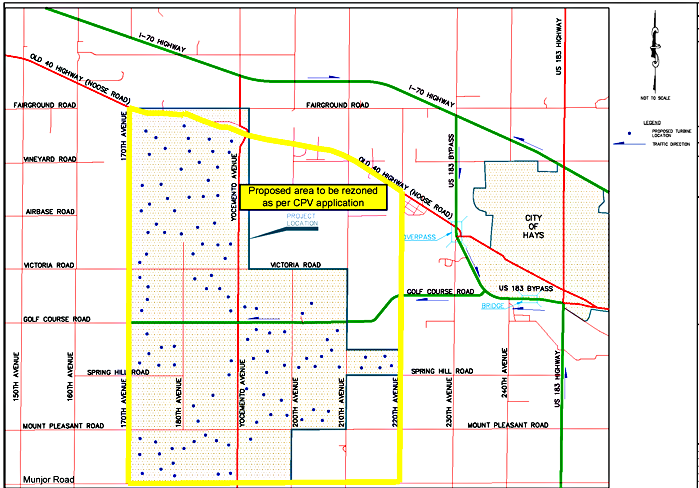
Given the unprecedented scale and impact of this development, no one can reasonably deny that such regulations are needed. In fact, the need for most of these regulations has been implicitly recognized by Iberdrola in their own "Good Neighbor Agreement" in which they request easements for noise, shadow flicker, communications interference, construction impacts, etc. The proposed ordinance explicitly provides for such mitigation agreements with a developer. However, it is the Coalition's position that the burden should be on the developer to abide by explicit regulations and conditions, rather than on residents to accept or reject an arbitrary proposal put forth by the developer.

The proposed regulations distinguish between small hobby-type turbines, personal turbines for farm use, and large industrial-scale wind energy facilities. Developers of industrial facilities would be obliged to follow regulations in the following areas, among others:

• Turbine setbacks from homes, property lines and sensitive areas
• Mitigation of soil erosion during construction
• Restoration of roads and bridges post-construction
• Preservation of water quality
• Restoration of any communication signal loss
• Limitation of noise pollution
• Electrical safety
• Deposition of adequate bonds to cover decommissioning
• Insurance requirements

The Coalition has repeatedly stated that it is not opposed to wind energy provided it is properly sited and responsibly developed. The proposed regulations do not rule out a wind energy facility in Ellis County, but simply ensure it will be sited so as to minimize negative impacts on the community, rather than simply to maximize profitability for the developer.

Proponents can argue that some of the proposed regulations are too stringent, but they cannot argue that they are not needed. The specifics can be debated, but a public consensus could be reached. To proceed with this development as is, without any regulatory control, would grant Iberdrola free rein to do as they please on 10,000 acres, without holding them to any environmental standards, and without providing the community any legal recourse in worst-case scenarios. Do we really need the development that badly?