Monday, June 4, 2007

Money Cannot Replace Trust

The following letter was written by Melinda Pfannenstiel, June, 2007:

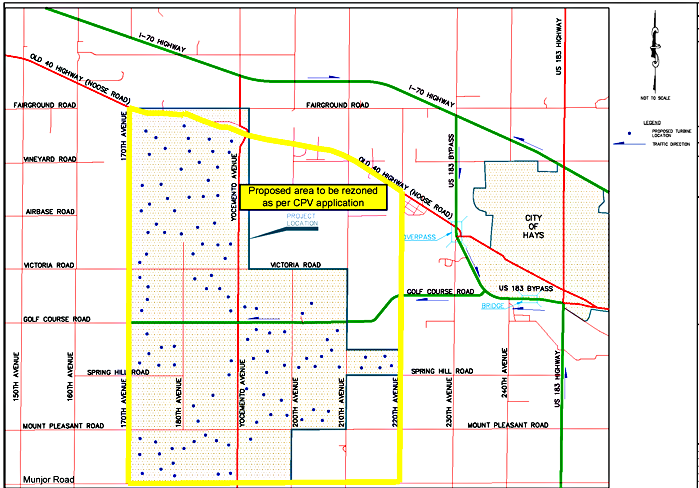
Trust lost over wind farm issue I am sure that I don’t have to mention to everyone that Ellis County is a tight-knit community, especially those that live rurally.

Those of us living southwest of Hays were tight even before the wind farm issue ever surfaced. We all live our own lives and respect each other. We know our neighbors and we can depend on them when we are in need. I am very disappointed in the manner in which the (proposed) wind farm came into being.

Those who are responsible for this project have betrayed us, their neighbors, by their behind the scene involvement.

Highly respected citizens have ruined their reputation amongst the people who matter the most, their neighbors.

Webster defines “trust” as a firm belief or confidence in the honesty, integrity, reliability and justice of another person or thing.

I don’t believe your (proposed) wind towers (could) ever earn you enough money to buy back the trust of your neighbors, the people of Ellis County.

This letter from:
Melinda Pfannenstiel
1235 Munjor Road
Hays, Kansas

Friday, June 1, 2007

Incredibly Shortsighted: Our Community at Risk

The following letter was first submitted to the Hays Daily News by Jerry Green, a resident of Hays and Ellis County, Kansas:

The proposed wind farm will create long-term care problems for Ellis County and is incredibly shortsighted.

This will hurt future economic development in the county and will damage our quality of life. The wind farm LLC has billions of dollars of assets and can afford multiple defeats. If they lose this battle, you can expect that the fight will continue until they prevail. As a county, we can afford only one loss.

Years ago, I joined with others to fight the location of a lead smelter in Ellis County. The proponents of the smelter, including the Ellis County Coalition for Economic Development, The Hays Daily News, the city of Hays, etc, tried to convince people that it was only a local issue and not an economic and/or health issue. Like the proponents of the smelter, supporters of the wind farm are framing this issue precisely the same. The truth has not been accurately presented. This is a county wide problem with serious long-term consequences for Ellis County.

I spoke with one of the city’s largest employers, whose local attorney would not represent them in attempting to stop the windmills. This employer stated that they would not locate their business in Hays today if there was a wind farm. In this battle, we face a number of multi-billion dollar limited liability corporations that seemingly change names daily. When these towers are decommissioned, which LLC (the one with assets and/or repair these towers?

How can our county afford this high cost? Every citizen of Ellis County shares this liability and all our families are at risk. Proponents of the wind farm have failed to address the serious economic problems which could arise from the wind farm.

Setting aside the economic and environmental problems, the 380-foot towers on top of 200-foot hills will represent visual pollution of a staggering nature.

Imagine what 135 seemingly 60-story metal monstrosities will look like from most points in Ellis County. Consider what these sky scraping towers look like at night with blinking lights covering them. We will have urban sprawl without any of the advantages. The economic development coalition and the windfarm LLC are touting the 15 possible new jobs as an “economic boon.” Is this not ridiculous? A small lawn service company would provide more jobs.

This array of giant windmills might offer a photo opportunity for politicians seeking votes and redemption for their carbon footprint but would otherwise be distasteful. Will future companies want to locate here and, more importantly, will our children and grandchildren want to reside here?

I do not believe that the wind blows any less 15 or 20 miles away from this population center. Why can this development not be moved 15 or 20 miles? The idea of a 1,000-foot set-off from adjoining property owners on structures of this magnitude is obscene.

Five miles would be more realistic set-off and would be implemented if we had a zoning board that could have made that call.

The farm would not locate here without county-wide zoning (which provides them liability protection.) I am starting to understand why a vote on countywide zoning was not allowed in Ellis County.

...With an issue of this magnitude the weight of this decision should not rest upon three people.

I do not believe that it is ethical to ask us to degrade our environment and place our community at risk.

Contact your county commissioners .

Jerry Green
Hays, Kansas
May 2007


To contact your county commissioners, call (785) 628-9410 and ask to speak to Perry S Henman, 1st District, Dennis J Pfannenstiel, 2nd District, or Vernon L Berens, Chairman, 3rd District. Or you can write to your commissioner to express your concern about the wind farm, addressing your letter to 1204 Fort Street, Hays, Kansas. Additionally, you may attend any county commission meeting and ask to address the group to express your concerns. The meetings are public meetings. The Board of Ellis County Commissioners meets in Regular Session at 8:45 a.m. every Monday (unless a holiday, then they will meet on Tuesday) in the Commission Room at the Courthouse, 1204 Fort Street, Hays, Kansas.

To Sign the Petition:

If you are an Ellis County, Kansas, resident and you wish to support a petition to request a moratorium on granting permissions to the wind farm rezoning, and to stop it, at least temporarily, from being constructed next to Hays, Kansas, you can follow this link and leave your name, real address, and a single comment about your support of this petition. Click here now!

Sunday, May 27, 2007

How Green is the Wind?

I want to briefly address one claim made by wind energy promoters: wind power will help reduce CO2 emissions that contribute to global warming. Superficially, it makes sense that generating power from wind would reduce emissions from burning coal, but that is not the whole story. In order for this claim to be true, the total reductions in CO2 emissions obtained from commissioning a wind turbine must exceed those created by its fabrication, transport and installation.

In fact, the intermittent and unreliable nature of wind energy production does not permit conventional power generation plants to be taken off line, and can actually reduce their efficiency because they must now be fired up or down on a regular basis in order for the grid to utilize the unpredictable power generated by wind. Considering the small amount of power generated by a wind turbine, the net reduction of CO2 emissions in overall electrical power generation achieved through its operation can't be very significant, and could actually be negative in some cases.

The huge wind turbines currently used to harvest wind power each weigh 120 tons or more and are made of various metals and advanced composite materials. These materials must be either extracted from the earth and refined, or fabricated from organic materials or petroleum products, leading to the release of many tons of CO2. Much more CO2 and many additional greenhouse gases are released during the process of fabrication and every factory worker in the plant contributes even more during his/her daily commute.

Next, consider that these huge machines must then be transported long distances (in our case from Pennsylvania to Kansas) on very large trucks releasing many additional tons of CO2. Once on site, huge quantities of diesel fuel are consumed by earth-moving equipment in road and site preparation, quarrying and milling of rock, trucking thousands of tons of gravel, cement, water and rebar (itself made of steel that releases large amounts of CO2 during smelting) and by the massive cranes (also transported long distances) that are required to erect the turbines. Think about this and you will begin to understand why big oil companies are buying interests in wind power and seeking to promote it.

When all this is considered, you arrive at an estimate that each turbine must operate at full capacity for about seven years to recover the carbon footprint of its installation. However, even the most optimistic projections suggest that only about 1/3 of 'nameplate' capacity is achievable, so now we need more than 20 years of turbine operation just to break even on CO2. And how long are these things supposed to last ?

But its all green power from there on, right ? Nope. You still have to budget for decommissioning - thousands more tons of CO2 emissions from heavy machinery transport and operation during salvage and site restoration - unless you are willing to simply abandon the turbines once they are beyond repair. So it is preposterous to claim any CO2 reduction from wind power; if anything, the promotion of wind power in its present form (and at taxpayer expense) is simply increasing consumption of fossil fuels and accelerating CO2 emissions. It is also putting more money into the pockets of big oil companies while the leaders of our government get to 'greenwash' their electorate into believing they are actually doing something about global warming.